From 1725 until the 1800, British ships led the transatlantic slave trade, kidnapping over 2 million African people according the Equal Justice Initiative.
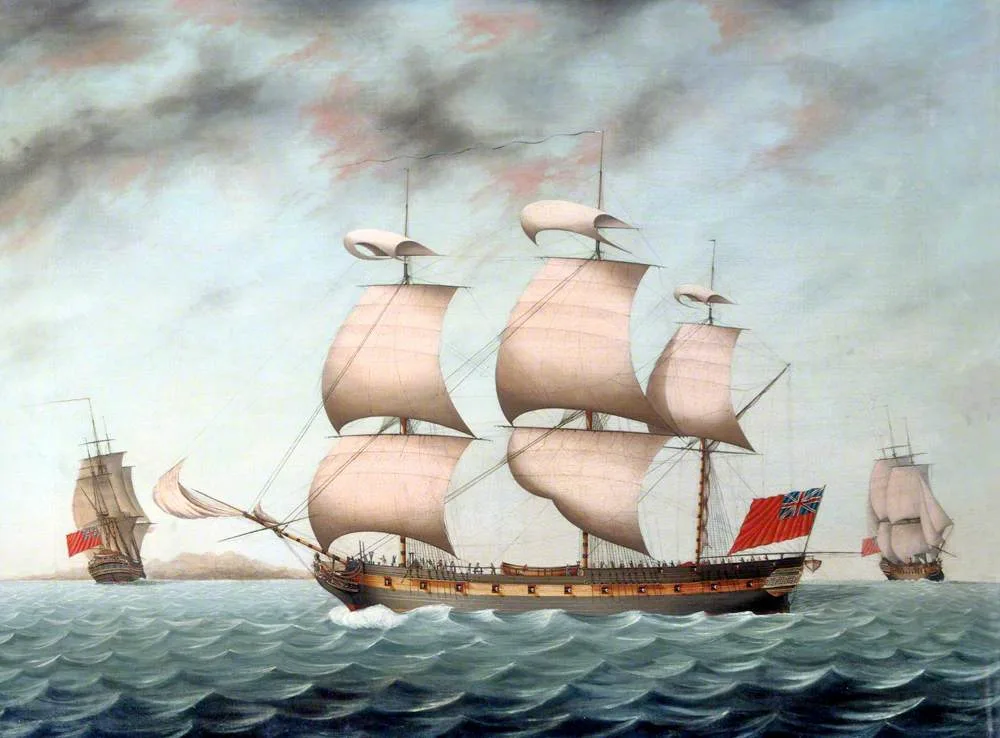
British ships and financial investment within the Trans-Atlantic Slave trade were integral to the trade's devastating success. London was central to the building of ships, trafficking and enslavement of African people, and the trade of goods produced under slavery. London became an economic hub, directly profiting off of the labor of enslaved people alongside the merchandise such labor produced including sugar, cotton, and tobacco.
Although France trafficked the majority of enslaved people to Saint-Domingue (Haiti), outfitted ships further traveled to French Guinea, present-day Louisiana, and Martinique. Those kidnapped and sent to Haiti were mainly forced to work on sugar plantations.
Third to Portuguese and British ships, France played a significant role in the Trans-Atlantic Slave Trade, in no small part given their trafficking of enslaved people to Haiti prior to the beginning of the island's revolution in 1791. According to Slavery and Remembrance, Le Havre was the first major slave port in France.
According to the Equal Justice Initiative, from 1625 to 1867, "ships from Portugal and its colony Brazil alone were responsible for trafficking 5,849,300 kidnapped Africans during this time period." Portugal both cultivated and dominated the Trans-Atlantic Slave Trade, trafficking people to ports mainly in Brazil such as Rio de Janeiro and Salvador in Bahia.
Alongside other Iberian ports such as Lisbon and Seville, Cádiz was one of the main architects behind the Trans-Atlantic Slave trade alongside Portugal. Prior to the 18th century, Portugal and Spain trafficked over 500,000 enslaved people to the Caribbean and Brazil.
Newport alongside other Rhode Island ports such as Bristol and Providence trafficked over 111,000 African people into the Americas.
American ports such as Boston worked as both exporters of slave ships and importers of trafficked African people. Massachusetts was the first New England Colony to legalise slavery, eventually abolishing it 140 years later in 1783. However, abolishment does not equate to a stagnancy in direct particpation in the slave trade. The Crimea, a slaving ship, departed Boston for Africa in 1857, capturing 600 off the coast of the Congo and trafficking them to Cuba.
Rio de Janeiro was the most significant port for the trafficking of enslaved African people throughout the 17-19th centuries. Throughout the 17th century, sugar dominated Brazil's exports, demanding an expansion of sugar plantations that further fueled the growing Trans-Atlantic Slave Trade. Slavery was not officially abolished in Brazil until 1888.
Over 1.3 million enslaved people were trafficked through Bahia throughout the Trans-Atlantic Slave Trade, making Bahia ports one of the most significant ports for the trafficking of human beings not simply in Brazil, but all of the world.
Beginning soon after the first slave voyage to arrive in the Americas in 1519, enslaved people were trafficked through Pernambuco until 1851, the majority of whom were trafficked through Brazil from 1700-1851.
Virginia was the first British colony to legalize race-based, hereditary enslavement in 1662. Between 1727 to 1767, over 11000 enslaved African people were funneled through Richmond. Following the national ban on the international slave trade in 1808, Virginia (with Richmond in particular) then became the one of the leaders in the domestic slave trade, trafficking hundreds of thousands of people into the deep south. Virginia itself primarily forced enslaved people to work on tobacco plantations. Work was demanded from adults and children alike from dawn until late in the night, with some accounts noting there were no pauses for food. According to the Equal Justice Initiative, 'Most trafficking vessels bound for Richmond carried kidnapped Africans from Guinea, the Gambia, and Sierra Leone in groups of 200 or more.'
Georgia's oldest city and founded in 1733, Savannah, the state quickly legalized race-based, hereditary slavery in 1755. By 1790, over three quarters of the Catham County population was made up of enslaved black people, where Savannah is located. Further, Savannah was strategically founded as a barrier to then Spanish occupied Florida, blocking escaped slaves from reaching freedom. Georgia initially trafficked many enslaved people from the Caribbean. However, but the 1770s, the majority of enslaved people were kidnapped in Africa, likely in an attempt by colonists to exploit knowledge of rice cultivation. In 1798, Georgia banned the international slave trade. However, this was not a move toward abolition, but rather to inflate the value of domestic enslaved peoples, and maintain the production and trafficking of slavery a domestic affair.
During the late 18th century, approximately 16% of all enslaved people trafficked across the Atlantic passed through the Bight of Biafra, culminating in over 680,000 people, Equiano being one of them.
Over 880,000 people were trafficked into Jamaica through Kingston from 1517 to 1807 often forced to work on sugar plantations. Jamaica was also the site of numerous revolutions, wars, and insurrections initiated by those enslaved. Namely, the First Maroon War in the later 1730s, the Second Maroon War in the 1790s.
Over 490,000 people were trafficked through Bridgetown, Olaudah Equiano being one of them.
Terms and Agreement: This work falls under CC-BY copyright, meaning users can redistribute, build upon, reproduce, adapt, etc. this project, so long as they credit myself as the original creator. Additionally, this copyright allows for commercial use