Olaudah's birthplace in 1745, where he was raised prior to his kidnapping in 1753.
Equiano was likely taken to along the Niger River following his kidnapping, eventually separated from his sister. Prior to reaching the coast, Equiano was sold to a number of different people in Africa, such as a chieftain who spoke the Igbo language Equiano grew up with. In nearing what was likely the Bight of Bonny, Equiano briefly reunited with his sister in a chance encounter before again being separated. There is no known record of Equiano's sister beyond this final meeting.
About 6-7 months after his capture, Equiano was likely forced along the Niger River to the Port of Bonny. Equiano was sold to British slavers and forced aboard a ship titled The Ogden in 1754.
While stuffed beneath the deck of The Ogden alongside numerous other enslaved people, Equiano survived the Middle Passage despite falling sick.
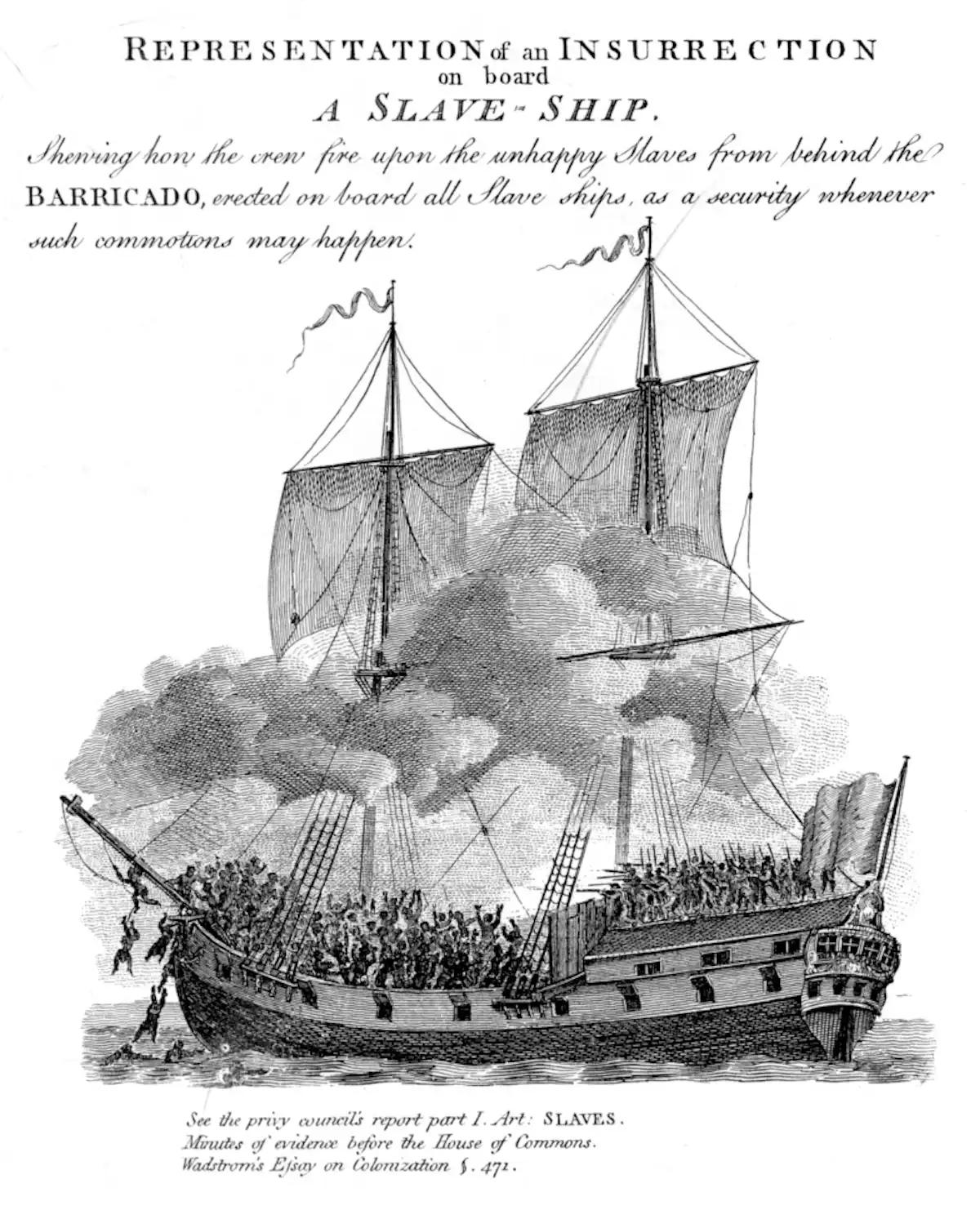
Arriving May 9th, Equiano alongside others aboard the ship survived the middle passage, landing in Barbados, a British Colony. Almost immediately upon landing in Bridgetown, Equiano describes the chaos of the slave market, in which "we were conducted immediately to the merchant's yard, where we were all pent up together like so many sheep in a fold". The separation of families and friends are enmeshed in the foreign environment of the port town, in which the astonishment of horses, multi-storied houses, and social cultures are intrinsically tied to the Trans-Atlantic slave trade. However, Equiano was not sold and thus was forced aboard a 'sloop' toward North America.
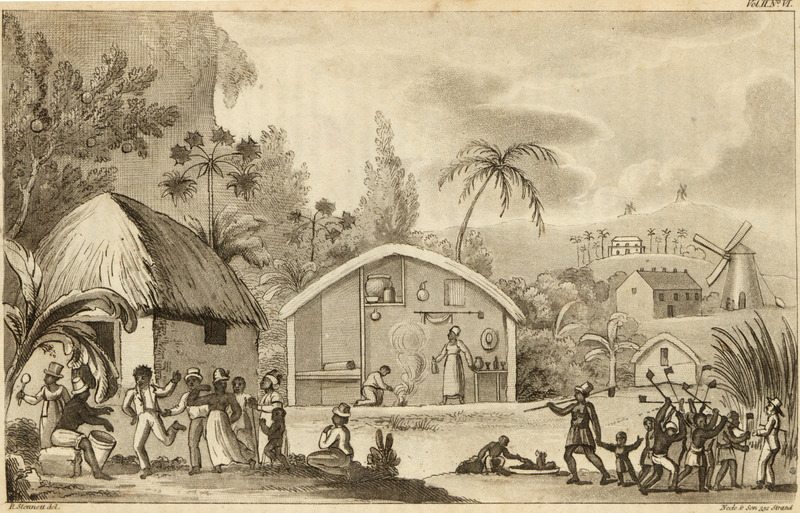
Landing in Virginia, at the time a colony of the British Empire and fueled by the tobacco industry, Equiano was sold to an English sailor, Henry Pascal. Still within the year 1754, Equiano was sent to England. While sailing to England, Pascal assigned Equiano the name he would go by the majority of his life, Gustavus Vassa. However, Equiano initially refused to respond to the name.
In the spring of 1757, Equiano arrived for the first time in England, where he first witnessed an Anglican church service. Here Equiano began engaging in Christian religious practice, converting to Christianity later in life. In fact, Equiano's portrayal of his relationship to religion plays a significant role throughout his memoir.
First arriving in the summer of 1757 following Pascal's appointment as a lieutenant of the British ship the Roebuck. Equiano describes befriending a number of boys his age on the ship. However, during this time passengers and sailors aboard the Roebuck often had the boys fight each other. Sailing to Scotland and Holland, Equiano learned many skills regarding sailing that would prove invaluable to his later freedom and employment. In living aboard a naval vessel, Equiano received schooling. Until 1762, Equiano was a forced participant in the 7 years war, traveling with Pascal aboard various naval vessels.
Equiano was baptized here on February 9, 1759.
While enslaved by Henry Pascal during the 7 Years War, Equiano, aboard the HMS Namur traveled to Gibraltar, tasked with patrolling the Mediterranean.
In December 1762 and upon hearing a rumor that Equiano planned to escape, Pascal sold Equiano to a Captain James Doran despite promising to free him at the war's conclusion. Doran was sailing to Montserrat and forced Equiano under strict rule, forbidding him from speaking English.
Upon landing in Montserrat, Equiano was sold by James Doran to Robert King, a Quaker merchant originally from Philadelphia. Recognising Equiano's education and maritime skill, King positioned Equiano as a merchant and accountant, essentially loaning him to other merchant ships or upon one of King's many vessels. Through traveling to ports and trading goods, Equiano managed to acquire a slow source of income, which he presented to King in 1766, successfully purchasing his own freedom.
While enslaved by Robert King, Equiano traveled to Charleston, trading goods and enslaved peoples either from the Caribbean or 'natives of Africa'.
A Dutch colony, Equiano traveled to St. Eustatius while enslaved by King, often with the Captain Thomas Farmer. The merchant ships Equiano was forced to worked on traded enslaved people between Montserrat, St. Eustatius, North America, and Africa. Other islands Equiano visited at this time include Santa Cruz and St. Kitt's.
Equiano traveled to Santa Cruz while enslaved on merchant ships captained by Thomas Farmer and owned by Robert King.
Equiano traveled to St. Kitt's while enslaved on merchant ships captained by Thomas Farmer and owned by Robert King.
Founded by quakers, Equiano had a particular fondness for Philadelphia throughout his life. He first traveled there in the beginning of 1765, a year before purchasing his freedom. Equiano describes selling goods to the quakers of the city who 'always appeared to be a very honest discreet sort of people'. King, the main enslaving and effectively trafficking Equiano, was himself a Quaker.
Although King treated Equiano comparatively well compared to the other men who'd enslaved him, King contrasted the abolitionist and egalitarian values of the Quaker church. His intention in purchasing Equiano in Montserrat was not to aid Equiano's push for freedom, but rather to exploit his skills as a merchant and sailor. This is epitomised in Equiano's first trip to Philadelphia, in which he narrowly avoided being sold by King following another rumor that he intended to run away. Years after his freedom, Equiano again sailed to Philadelphia from London as a merchant, addressing a conglomerate of Quakers commending their abolition work.
Terms and Agreement: This work falls under CC-BY copyright, meaning users can redistribute, build upon, reproduce, adapt, etc. this project, so long as they credit myself as the original creator. Additionally, this copyright allows for commercial use